Friday, 12 January 2018

A Picture is Worth 1000 Birds: Life Birds in Trinidad

We escaped the bitter cold of Toronto to head way south to South America to find birds, birds, birds.  We arrived in Trinidad at about 1:00am on the morning of January 4, having left Toronto the previous afternoon.  We arrived tired and weary, but Sue’s suitcase did not make it past Newark Airport.  We have now just wrapped up the final day of our week-long birding adventure and United Airlines is FINALLY sending the suitcase to Port of Spain Airport.  Just in time for us to pick it up on our way home. 


However, the suitcase wasn’t here to see birds, we were.  Sue had been to Trinidad 15 years earlier so she wasn’t going to get nearly as many Lifers as me.  I arrived with 949 and was really hoping to get at least 51 new species to hit 1000.  And that happened on our hike to find the rare and secretive Oilbirds, on our final day at the Asa Wright Nature Centre.  Interesting story behind their name too, as Jesse, our guide pointed out.  Once upon a time people would spear the young birds and render them down because the high-fat content of the young birds would produce a lot of good oil for torches and the like.  They are also the only nocturnal, fruit-eating bird and find their way using echolocation, just as bats do.

They live in a riparian grotto on the property of the Nature Centre and on our final day there we got to take the hike to see them.  It was a pretty good hike up and down wet, muddy and slippery trails to the grotto, and we saw plenty of birds along the way, but once down in the grotto, feeling like we were on an Indiana Jones crusade, and after wading through a little stream, we finally got to see one of  three prized bird species of Trinidad:

Some of the nearly 200 Oilbirds of Dunston Cave.  The Oilbird was species 1000 since I began birding in January 2012.  


  Entrance to Dunstan Cave, home to Oilbirds


January 4, 2018:


We began our trip birding on the balcony of the Asa Wright Birding Centre last Thursday with a Bearded Bellbird in one of the guide’s scopes, number 952.  The balcony is also one of the best places in the world to see a wide variety of hummingbirds up close and personal. I added 16 species that afternoon from both the balcony and a walk around the grounds.

Day 1, 16 Lifers:

Bearded Bellbird
Crested Oropendola
Channel-billed Toucan
Cocoa Thrush
Copper-rumpled Hummingbird
Green Hermit
Purple Honeycreeper
Silver-beaked Tanager
Spectacled Thrush
Tropical Mockingbird
Tufted Coquette
Violaceous Euphonia 
Turquoise Tanager
White-chested Emerald
White-lined Tanager
White-necked Thrush

Channel-Billed Toucan:                                            


                         Two male Tufted Coquettes battling over territory:


January 5, 2018:


The next day we were given a guided tour of the grounds with Elizabeth.  She took us to a few good locations and pointed out birds we would never have seen or identified on our own, including the beautiful Golden-headed and White-bearded Manikins.  We even saw both male and female Bearded Bellbirds up close.  Elizabeth was so excited because people rarely see the females since they don’t make a loud call like the males.  After lunch, Sue and I found a Guianan Trogon on our own.  That evening, with our private guide and local bird expert, Mukesh, we went to the old airfield for looks at the Moriche subspecies of the Epaulet Oriole, one of the few places this species can be found.  We also got to see a beautiful Sulphery Flycatcher.


                           Guianan Trogon:

Sulphury Flycatcher:


Day 2, 9 Lifers:

Forest Elaenia
Golden-headed Manakin
Golden-olive Woodpecker
Great Antshrike
White-bearded Manakin
Guianan Trogon
Epaulet Oriole (Moriche)
Rufous-tailed Jacamar
Sulphury Flycatcher


January 6, 2018:


After breakfast on the third day, we hit the road, literally.  Blanachisseuse Rd, leading north in a loop from the nature centre provides great birding along a narrow and scary road.  I sat in front full of anti-nausea meds as we wound our way around from village to village stopping along the way to bird in a variety of high altitude forest locations. Highlights were Long-billed Gnatwren, White Hawk, a Bat Falcon and a beautiful Speckled Tanager, which flew before I could get a photograph.  We got great, but distant looks at both male and female Bellbirds, which even long-time Trinidadian birders have rarely seen.  We got rained on frequently, but often there was a rainbow to go along with the amazing vistas.

Some of the views and birds from the day:

                                          Blue-black Grassquit:

                                           Bat Falcon:

                                            Rufous-tailed Jacamar:

                                    Green-backed Trogon:


Day 3, 11 Lifers:
.
Black-headed Parrot
Carib Grackle
Common Black Hawk
Green-backed Trogon          
Gray-breasted Martin
Grayish Saltator
Long-billed Gnatwren
Rufous-breasted Hermit
Speckled Tanager
White Hawk
White-winged Becard

January 7, 2018:

Day four at Asa Wright was another day of driving from destination to destination in search of a wide variety of lower elevation species.  Our eventual destination was to Nariva Swamp, where we got to enjoy birds such as the White-headed Marsh Tyrant, Pied Water-tyrant, Yellow Oriole and Yellow-chinned Spinetail.  Once again, our guide for most of the trip, Mukesh, was able to hear and spot birds we didn't even know were close by.  Sure we did okay on our own from time to time, but having local guides is what put me at 999 birds going into our last day at Asa Wright Nature centre.

Our view of the Caribbean Sea while we ate lunch on the way to Nariva Swamp:


       Yellow-chinned Spinetail: 

                                      White-headed Marsh Tyrant:

                   Pied Water-Tyrant:


                    Yellow Oriole:


Day 4, 13 Lifers:

Black-crested Antshrike
Blue-and-yellow Macaw
Pied Water-tyrant
Southern Rough-winged Swallow
Striated Heron
Trinidad Euphonia
White-winged Swallow
Yellow Oriole
Yellow-chinned Spinetail
Golden-fronted Greenlet
Gray-rumped Swift
Gray-throated Leaftosser
White-headed Marsh Tyrant


January 8, 2018:

It was our final evening at the Asa Wright Nature Centre, where the food and views were equally spectacular, when we took a boat trip to see the second of three species that were one of the main reasons for coming to Trinidad, the Scarlet Ibis.  That morning we had seen the Oilbirds and I had finally seen the Blue-chinned Sapphire hummingbird.  On the way to the Ibis we stopped to get close-up looks at a beautiful Red-breasted Meadowlark,(ie blackbird) and the striking Masked Cardinal, just outside Caroni Swap.  The Scarlet Ibis come in to roost there every evening.  Birders from all over the world take the boat trip at dusk to witness the spectacle of the more than 500 Ibis as they arrive.  Many, like me, sipping a rum punch.

Sue, me and our guide to the Oilbirds:


                     Red-breasted Meadowlard,(Blackbird as it is locally known):


                                Masked Cardinal:


             Scarlet Ibis:


Day 5, Lifers:

Oilbird
Blue-chinned Sapphire
Red-breasted Meadowlark
Long-winged Harrier
Masked Cardinal
Red-rumped Woodpecker
Bicolored Conebill
Cocoi Heron
Scarlet Ibis
Green-rumped Parrolet


January 9-10, 2018:

We concluded our trip in Grande Riviere where we were seeking the final bird of the Trinidad trifecta, the Trinidad Piping Guan.  Mukesh drove us up there, along a very winding, not very good road, where he got us one last bird for his portion of the guiding, a Pale-breasted Spinetail.  We had a good dinner that night at Mt Plaisir Estate Hotel, where we spent the night, and the next morning the owner himself, Piero Guerrini, drove us up to the Pawi Nature Centre at dawn so we could witness the incoming pawis ourselves.  They are not seen but a few hours every morning as they come to the wild nutmeg trees for breakfast.  Afterwards, with a couple of other birders, we ventured down the road and added three more lifers before our final bird of the trip, as Caribbean Martin on the wires along the main road.

The Indiana Jones of Birding:

 View from our Hotel:


       And the star of the show, the Trinidad Piping Guan, or Pawi as it is locally known:


Day 6 and 7, Lifers:

Pale-breasted Spinetail
Trinidad Piping Guan
Black-tailed Tityra
Euler’s Flycatcher
Yellow-bellied Elaenia 
Caribbean Martin 
We left Trinidad both adding lots of Lifers.  Sue had 17, but I added 65 and am now at 1009 all time,(accounting for lumps and splits in the avian world, otherwise I'd have 1015).  Sue will need a trip somewhere she's never been to catch and pass me on the Life List again.  Perhaps I'll sit that one out ;)

Monday, 1 January 2018

New Year, New Birds!

Six years ago today I began a quest to become a birder.  I began birding by chasing a Smew in Whitby Harbor after seeing my first bird of my first year of birding, a Northern Cardinal, out my back window.  Over the next 366 days of the 2012 leap year I birded all across Canada and the US during my first Big Year.  I’m still learning and still obsessed with finding birds.  I ended 2017 birding with a bunch of folks all out for a rare visitor to Ontario, a Tufted Duck.  I have seen them on two occasions in the US but it was exciting to add the Tufted Duck to my Ontario Life list, which now stands at 316 species.

   Alas, the only photo I did get only shows a tiny bit of tuft behind the head:


To begin my new year, this January 1, 2018, a frigid day in Toronto, Ontario, I started the by birding in James Gardens.  For the first time since I started birding there were no birds at our backyeard feeders early on New Years Day.  My first bird of 2018 was, fittingly, a Blue Jay.  Birds did eventually show up at our feeders, the first of which was a White-throated Sparrow, picking seed out of a planter box::


This will be a another year for adding Lifers.  On Wednesday Sue and I are on our way to Trinidad for 7 full days of birding, on my first trip to South America.  Sue has been there, but since it’s my first trip there will be LOTS of Lifers and I will once again pass her on our friendly Life List competition.  There are over 400 possible species and 150 possible Lifers, which will finally put me over 1000 on my World Life list in my 6 years of birding.  

My other goal for the year is to visit states and provinces in the ABA area I have not birded in.  I have birded in 24 of the 49 continental US states and just 4 of Canada’s 10 provinces. I need to get to work on that.  In 2017 I added 13 ABA Life Birds, plus the Black-backed Oriole.  It will be hard to add that many species to the ABA List this year without a lot of travel.

Let the birding begin!

Tuesday, 26 December 2017

Ending the Year on a Mountain High Note: The Quest for Rosy Finches

I have now been a birder for 6 years.  In that time I have done two atypical Big Years.  2012 was the beginning.  I began my birding obsession with a Big Year, starting from knowing nothing of birding, working full time and because of my work travel schedule, was able to see 601 species,(596 ABA).  In 2016 while traveling with the Blue Jays I did a Big Year in all the cities and states the Jays visited during the season and counted exactly 400 species. Over all that year, I saw 483, 17 short of the 500 I had hoped for.  In 2017, I have been unable to even see 400 species.  This past year I underwent spinal surgery, not once, but twice back in March and have birded as opportunites and my back health have allowed.  Yet, mostly targeting Lifers, and having very specific targets, I arrived in New Mexico with 8 ABA Lifers for the year, plus a non-ABA Black-backed Oriole.  In 2016 I added a total of 13.  I’d need 5 to match last year and I had my target list, of course: Three species of Rosy Finch, Pinyon Jay and Sage Thrasher.

I got going straight out of the airport.  Picked up my rental, a Ford Focus, which I drive at home, making the trip so much more pleasant.  I drove directly up to Sandia Crest House, where the rosy finches frequent the trees and feeders around the gift shop.  It’s only open on weekends at the moment, and my plane landed just after noon on Sunday and wanted to get there before it closed.  I arrived atop the mountain just before 2pm so had plenty of time on the deck, watching the feeders and even had lunch there.  The rosy finches did not disappoint.  At first it was just a few Gray-crowned Rosy Finches and then I was able to spot a few Black Rosy Finches.  It wasn’t until later when a huge flock arrived and I spotteded a lone Brown-capped Rosy Finch.  


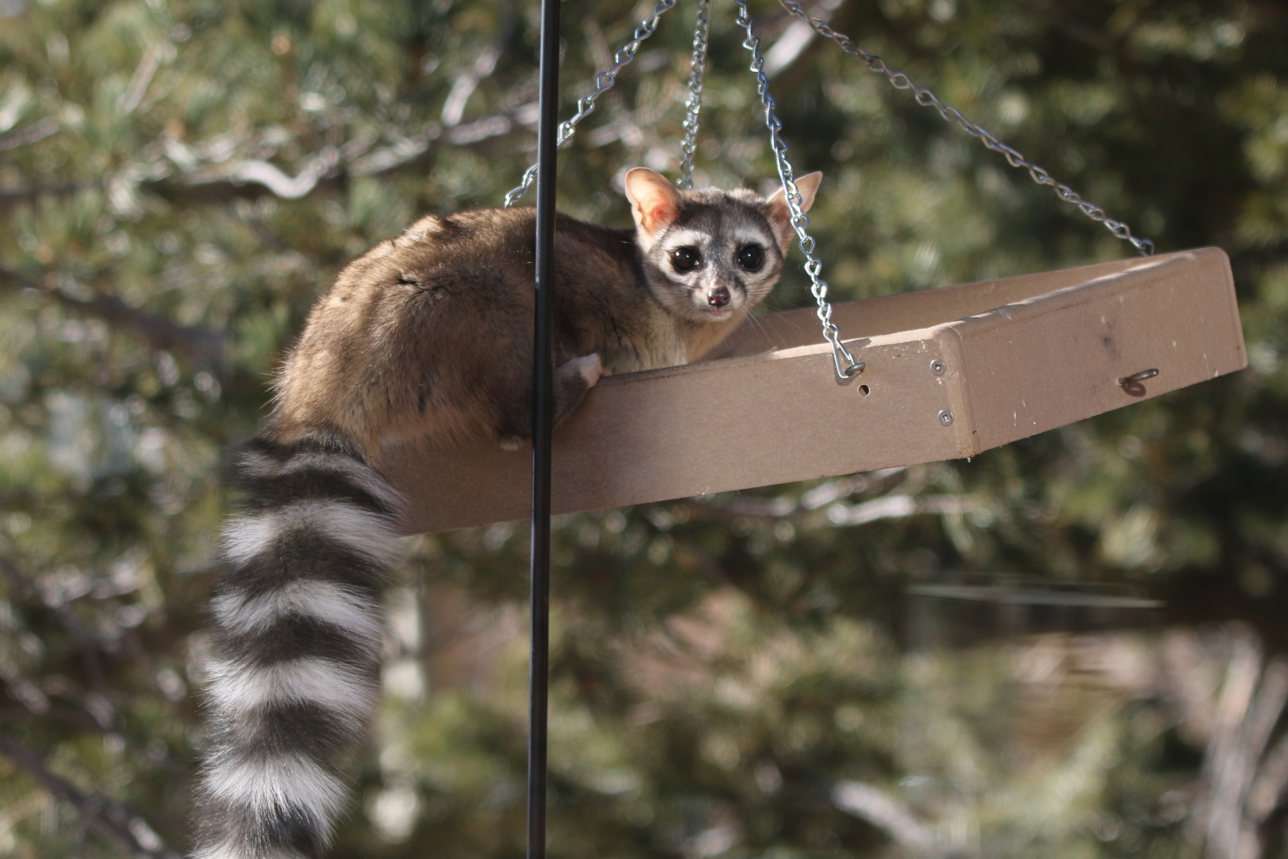
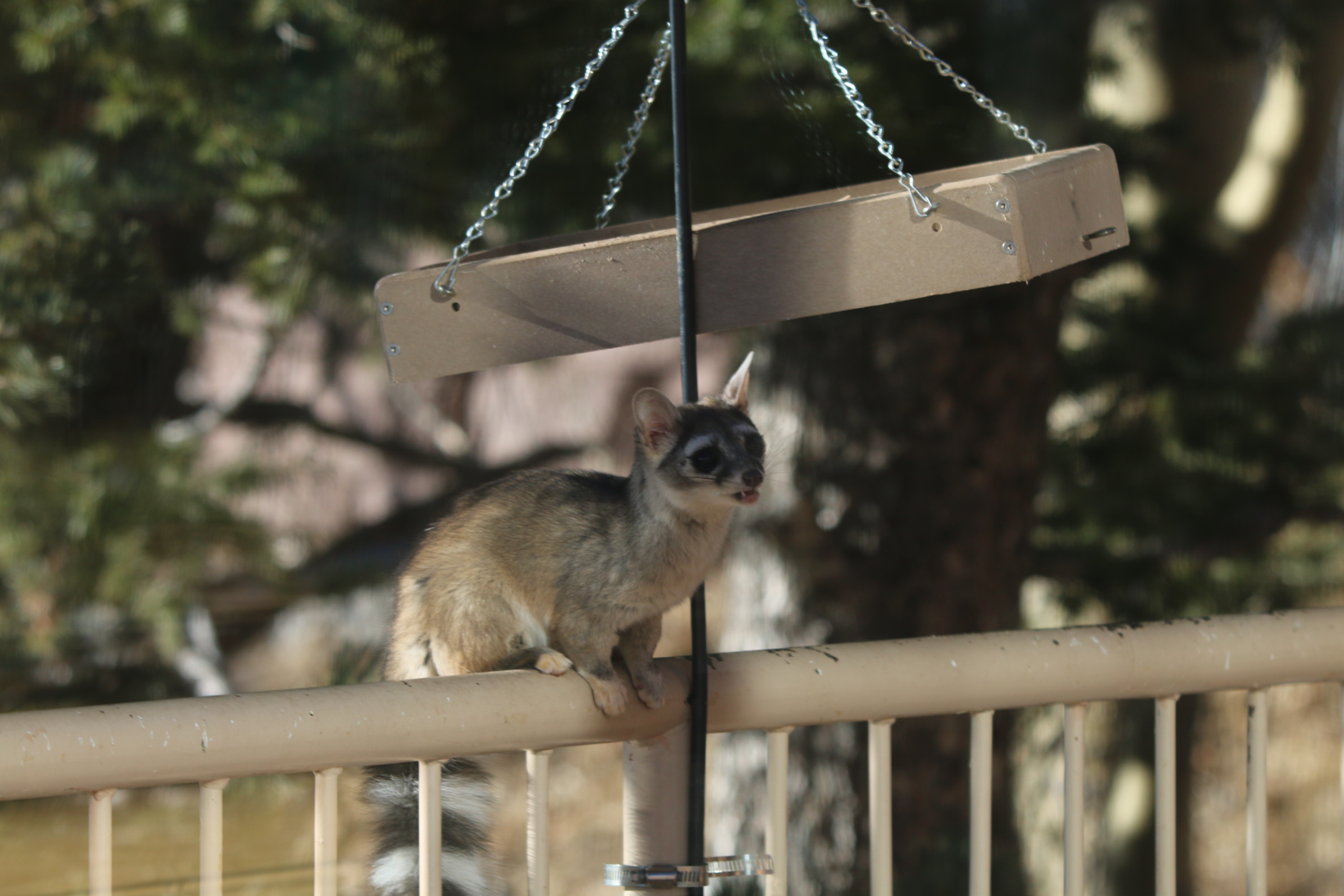
Aside from the birds, the views from atop the mountain were superb.  There was one other exciting moment.  A rare daytime visit from a Ring-tailed Cat, a member of the raccoon family that is normally nocturnal.  Two of the people who worked in the Sandia Crest diner and gift shop had not ever seen seen  one, and the third had only seen one in the dead of winter and only at night.


I was staying at Elaine’s Bed and Breakfast part way down the Sandia Crest mountain, 


and figured I’d go back in the morning and watch the feeder outside the Sandia Crest House.  This time the rosy finches put on a show.  Flocks of hundreds of them and ample opportunity to photograph them all.


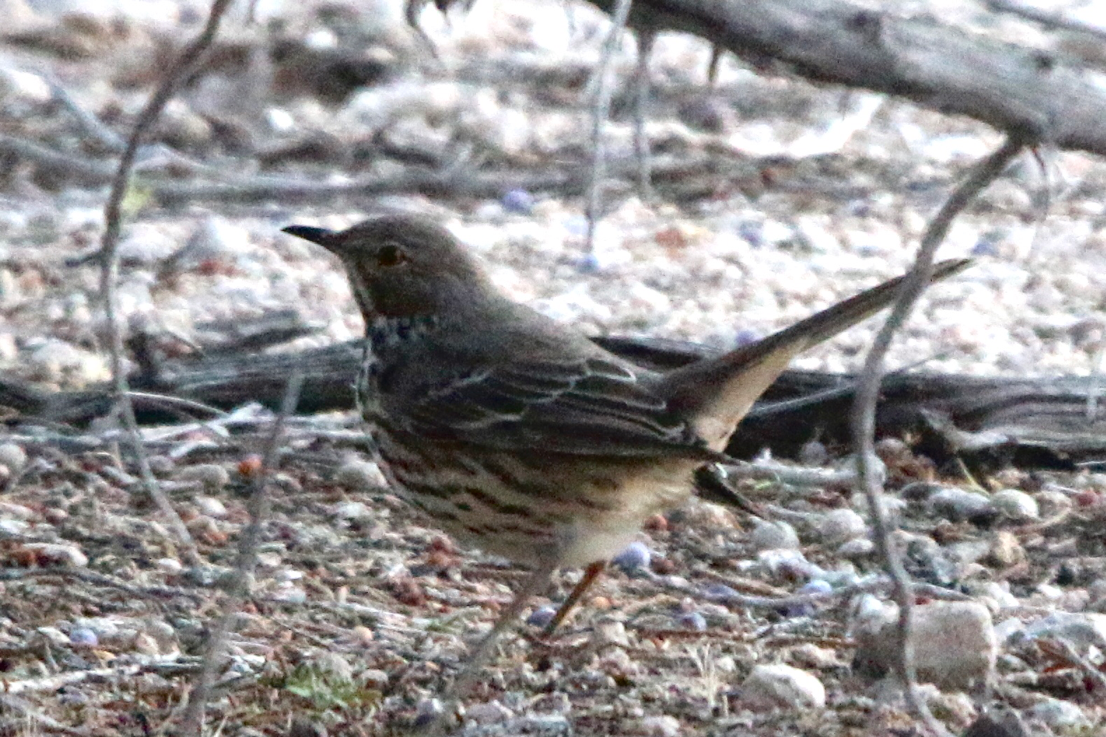
Over the next few days I was able to locate both the Pinyon Jay and Sage Thrasher, both birds that have also been long on my target list and finally have added to my Life List, which now stands at 668 ABA Species, with the addition of 5 in New Mexico and the substraction of the Thayer’s Gull.

                 Pinyon Jay:


                            Sage Thrasher:


Other birds and views from New Mexico:


                                Juniper Titmouse:                                                            


             Townsend’s Solitaire taking wing:


                       Mountain Chickadee:                                                                                             


          Cassin’s Finch:


Tuesday, 12 December 2017

Winter Birding Begins with a Barnacle Goose

With the beginning of the winter birding season, even though it was still November, it felt like winter, I was off on a trek through New York and Massachusetts with three very different goals in mind.  And for once, it was not all about birds.  Yes, a Barnacle Goose in Westfield, MA got the ball rolling, but there were a couple of other destinations that made the trip even better.  First, there was a place I’d heard of called “The Grand Canyon of the East.”  Less than 3 hours from Toronto I just had to see if it could live up to the name and I’d actually never been to the real Grand Canyon, so I scheduled a trip to New York over Thanksgiving Weekend to see it.  From there it wasn’t too far to go see the Barnacle Goose, but the third destination was the true cherry on top of this travel sundae.

Off the beaten path is a little known town in upstate New York called Ticonderoga.  It is also affectionately known as Trekonderoga.  For in this sleepy little village one man had a vision of building an exact duplicate of the sets from the original Star Trek TV series.  The one from the mid 1960’s with Kirk, Spoke and McCoy.  I am 57.  In the early 1970’s I was introduced to Star Trek on a black and white TV when it first hit syndication.  It was on at 4pm and I’d watch it religiously when I got home from school.  I’d get home around 3:45 and watch the final 15 minutes of General Hospital, where Audrey was on trial for a murder she didn’t commit, then spend the next hour on the Enterprise, going boldly on fantastic adventures.  I’d play Star Trek.  I’d build my own phasers and communicators.  I even had a failed attempt at building the captain’s chair from the bridge.  It was my dream to one day sit on the bridge of the enterprise in Captain Kirk’s command chair.  Well, folks, 46 years later, here I am:


Sometimes, even the wildest dreams of an 11 year old watching a cheesy 1960’s TV show on a black and white Philco television, do come true.

But back to the birds.  The next day, after a lovely buffet Thanksgiving dinner at truckstop in Danville, NY, I was off on my goose chase.


The Barnacle Goose was not a Lifer, as I had seen one during my 2012 Big Year, but had failed to photograph it and on subsequent trips to get a photo, had not even seen one.  This year, I had high hopes of not missing it.  I arrived early at the water treatment ponds in Westfield, New York, but there were only a dozen or so Canada Geese hanging around.  I hung around for about half an hour, and then decided to drive around and check out other areas where a goose might roost.  Nothing but a lovely old mill and barn that had been turned into a store and apartments by a river.


But upon my return to the ponds, I was greeted by a small flock of geese flying in from the north and landing in the pond.  Amongst them was the Barnacle Goose and I was treated to up-close views of the bird, along with his companion, a Cackling Goose.  I got my bird and I got great photos, digiscoped with my new iPhone X and PhoneSkope’s pre-release iPhone X digiscoping adaptor, as well as a few with my Canon DSLR:


Seems like I am documenting this trip in reverse, so let’s circle back to The Grand Canyon of the East which is located in Letchworth State Park.  It was quite a spectical and yet another amazing place I might have never seen if not for birding.  There weren’t many birds to see in the park, but the view was what I was there for:


Back home I found  a few nice migrating birds to add to my small year list, a Red-throated Loon, Snow buntings and a Snowy Owl:


Finally, in my back yard, the feeders brought in an unusual visitor, a semi-lueisctic House Finch:


Next stop as I finish off the year, a few days of birding in Florida and then off to New Mexico for a few Lifers.  Hopefully a trio of rosy finches and maybe a single Pinyon Jay.