Friday, 22 January 2016

Florida Before Panama

On the way to Panama, we got slightly sidetracked by the Space Coast Birding Festival.  I've heard of this festival for years but have never been in Florida at the right time.  This year, we took a pit stop on the way to Panama and spent two days on the Space Coast, looking for Red-cockaded Woodpecker and other winter birds, and taking a morning to go horseback riding at Forever Florida.  By the time we were done, we had seen 68 species including the Red-cockaded Woodpecker.  We had to wade through some typical Florida Swampland on a chilly morning to find it, but when we did, we were able to see two of them, mostly spending time cleaning their nest holes, before heading off to work for a day of foraging for their daily diet of insects, berries and nuts.  There are only a few places left in the North American south where fewer than 11,000 individuals inhabit the pine forests of Louisiana and Florida.


One of the trees where the woodpeckers set up housekeeping:


Doing a little morning nest hole cleaning:


Last check before flying off for a day of foraging:


Nearby we found a couple of Florida Scrub Jays:


An organized outing led in part by Florida bird expert David Simpson, to a beach near Daytona, where an estimated 30,000 gulls, along with a bunch of Sanderlings, stage on the beach...


... before heading out to sea, only to be harassed by Jaegers.  In this case a Parasitic Jaegers:


At the Merritt Island NWR Visitor's Centre we got a close look at the Painted Buntings:


We also drove the Blackpoint Wildlife Drive and enjoyed many hundreds of birds, including a Reddish Egret and a Roseate Spoonbill:


Wednesday, 6 January 2016

Long-eared Owl

So, about a week into my quest to eBird each and every day of 2016 I was once again going down to Col Sam Smith Park determined to find me some owls, having finally given up on Purple Sandpipers. The previous day I was there and was looking for either Snowy, or Long-eared Owls with no success. Snowy are regular visitors to the park but I had not yet seen a Long-eared Owl there. However, there had been reports of Long-eared Owls on eBird.  By the time I got to the park the rain had stopped and it wasn't long before a Cooper's Hawk chased a Long-eared Owl out from the bush. Another 20 minutes of searching resulted in finding one in some leafless bush, and having a second fly over. Only my 3rd time in 4 years seeing Long-eared Owls, and my first in Col Sam Smith Park, and number 162 for my park list.


New Year, New Goals, New Camera and Scope

January 1, 2016

More so than most pastimes, hobbies and obsessions, the New Year for birders means the start of a new list.  Some years it's all about the total number of species, other years it is about birding in new places, discovering new habitats, or traveling to the rainforests of tropical countries.  For me, this year, it's a little bit of both.  For 2016 I'm not focussing on total species, but more on finding species I've never seen, both in North America and, this January in Panama, and getting photographs of the 40 or so species I've failed to get pictures of, or have taken lousy photographs of over the last four years.  In order to reach that goal I bought myself a new camera, a Cannon 70D with a Sigma 150-600mm zoom lens, and a Vortex Razer scope that is a huge improvement on my previous model.

January 3, 2016
I'll be saving my money and scheduling my time to chase more rare birds in North America over the next 12 months and will be building the World Life List in Panama later this month.  I did, today go out looking for a Townsend's Solitaire, hoping to get some good photos.  Back in October, closer to home in Col. Sam Smith Park I did get some great pictures, but alas they vanished from all my saved media.  Not sure how that happened, but I was given a second Chance this morning, and alas we were too late.  I'll give it a try again tomorrow.

January 4-5, 2016

Drat!  No Solitaire.  So I will have to wait for the next showing of this rare Ontario species to redo my photographs.  Meanwhile, I have been out shooting photos with my new camera...

The pair of Peregrine Falcons were taken on a very cloudy day, zoomed at 600mm way at the top of the lift bridge in Burlington, with no cropping.


Sunday, 27 December 2015

... and One More Chase! December 27, 2015

Okay, so the last chase for the Western Spindalis was actually the Penultimate Chase of 2015.  Today, December 27, was the real, maybe, last chase of 2015.  And in a way it was kind of fitting, bringing things full circle from December 27 of 2012 when I was about to embark on what was, at the time, the crazy notion of doing a Big Year, without having any actual birding experience.  It had all started with the movie, The Big Year, followed by listening to the audio production of the book, The Big Year.  Late in December of 2011 Ontbirds and NARBA were reporting a male Smew in Whitby Harbour just outside Toronto.  Since my Big Year didn't start until January 1, I decided to wait until then to go see it.  Of course it was gone by then, never to return.


However, about a week ago, while I was still in Florida, and over Christmas, a female Smew showed up just west of Cornwall and I was finally able to go see it.  I was driving my daughter back to Kingston and it was only another hour and a half down the road.  On what was a wet, but somewhat balmy day for December I teamed up with several other birders, some doing a Cristmas Bird Count, who helped me find the Smew.  I hadn't brought my scope so it was a good thing I found such gracious helpers.  One thing about birders, unlike almost any other hobby, they will always come to your aid in finding rare birds.  I got looks at it in two locations, as a few of us chased it from one inlet to another. 

The Smew was ABA Lifer number 643 over the four years I've been birding.  It was also my 10th Lifer of 2015.  Based on numerical progression, having seen 20 new ABA species in 2013, 16 in 2014 and 10 in 2015, I expect to see at least 5 new ABA speicies in the new year.  But that and more will be my goal for 2016.

Below is the only photograph I got as the Smew was being chased by a Common Goldeneye:


After finishing with the Smew, I went out in search of Tundra Swans, Barrow's Goldeneye and a long staying Bullock's Oriole, as seen below.  Alas it was such a gray day that not many of photographs came out.


The only nice photo I took all day:


Tundra Swans:

As you can't see...

This is how most of the day looked liked through my camera lens:

Below, you can hardly see a Bald Eagle that flew over while I was looking for the Smew:


Friday, 18 December 2015

Decemberr 12 to 17, 2015: The Last Chase

Again, hearkening back to my Big Year, there was yet another rare bird chase in my future.  That is, if the bird in question stayed put in Florida while I conducted interviews in Nashville.  Throughout the week I kept checking eBird and the male Western Spindalis kept showing up in a park near Fort Lauderdale.  The penultimate bird of my 2012 Big Year was a female Western Spindalis in Key West Botanical Gardens.  This year a male showed up in Markham Park just outside of Fort Lauderdale and I was determined to see it, and get a photo.  Rare female birds are nice, but if you want great plumage, for the most part, you have to get the males.

It wasn't long after I got to the spot where this rare visitor from the Bahamas had been seen, that one of the birders already present, got his eyes on it.  For the next half an hour or so it showed itself and eventually came out in the open for all the photographers present to get a nice photo.


Along with the Western Spindles, frequenting the same trees, were two or three Spot-breasted Orioles, one of which is pictured below:


During my week in Florida I enjoyed a large variety of interesting birds.  Of particular interest was the White Ibis equivalent of the "push-mi--pullyu" from Dr Dolittle, along the Lake Apopka Wildlife Drive


Just a small part of 4 larger rafts of more than 1000 American Coots at Merritt Island Wildlife Drive


Black-bellied Whistling Ducks, Lake Apopka Wildlife Drive


Florida Scrub Jay, Merritt Island NWR Scrub Trail


White-winged Parakeet, Across from Ocean Bank on Le Jeune Rd in Miami


Thursday, 10 December 2015

As the End of the Year Draws Near: July 27 to December 9, 2015

And so I arrived back in Ontario at the end of July with a list of 400 species I had seen since December 10 of 2014, when I started counting my 365 day "year" with a trip to California.  I was just curious to see how many birds I could see in a calendar year that featured trips to Florida, Michigan, California, Texas, Arizona and British Columbia, but while not doing a Big Year.  Between July 27 when I saw Solitary and Baird's Sandpiper in James Gardens and November 30, when a Mountain Bluebird came calling from the mountains of the Midwest, I added 8 more species, giving me a total of 408 for a full 365 days of birding with lots of travel.  In 2015 while doing my first Big Year, I saw 596 ABA Species.  Seeing upwards of 600 species is really hard,(and really expensive)!
However, the final list of birds wasn't too bad.  With a trip to Cranberry Marsh in Whitby for a Hudsonian Godwit, Algonquin Park for Snow Bunting, and a Townsend's Solitaire in Colonel Samuel Smith Park, the "year" was wrapping up quite nicely.  The last new species I saw before December 9 was the best of all.  On November 30 I was back in Whitby at Lynde Shores Conservation area for a very rare and very cooperative female Mountain Bluebird.  This species is very near and dear to me.  It was one of my first rare bird chases.  On January 1st of my 2012 Big Year we went looking for a Smew in Whitby Harbour, but it had already left; a few days later a female Mountain Bluebird showed up.  I chased, I found and I froze that day.

This year, on a lovey, but cloudy fall day another lost Mountain Bluebird showed up on the other side of the GTA.  This one was bouncing from tree to tree, giving all who were present amazing and close looks at this are visitor from the Midwest.  So, with the addition of the Mountain Bluebird I finished my 12 months, from December 10, 2014 to December 9, 2015 with a respectable 408 species.


Rare birds always bring out a host of avid birders:


Thursday, 30 July 2015

West by South West: July 2015

West by South West: July 2015

July birding in the east, in the heat of summer, not so good.  But go west, and it's very birdy, and very hot, especially in Texas, in the heat of summer.  But first...

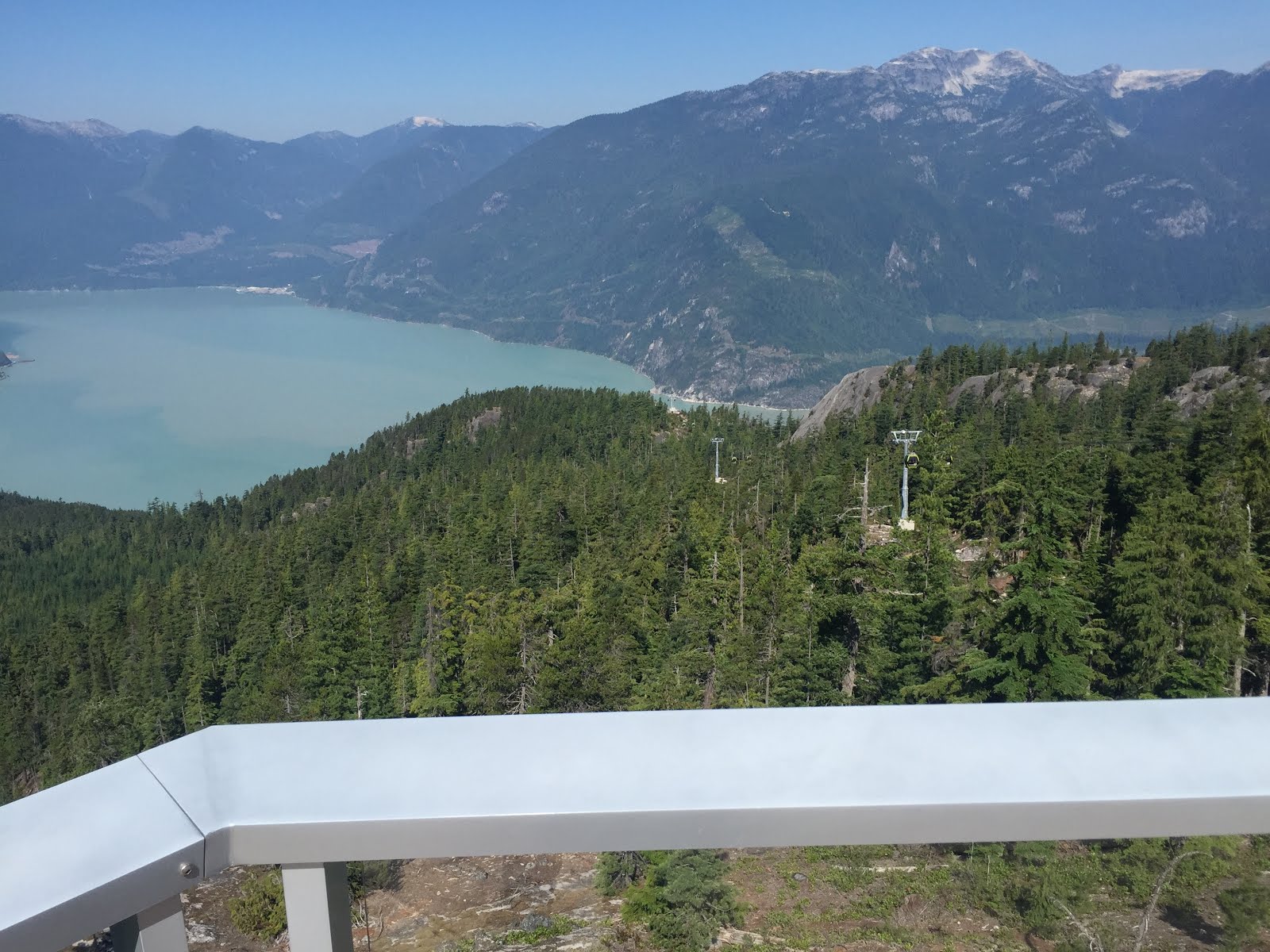
Every year I go to British Columbia for work, and it's not hard to stay for a few extra days.  Last year I took the ferry to Victoria, so this year I stayed on the mainland and revisited a few places I've birded before and took in the bird's eye view of the birds from atop a couple of the Greater Vancouver areas highest peaks.


Of course I was really just there for the birds.  I found the Chestnut-backed Chickadees, that make our own Black-capped Chickadees look quite plain, Steller's Jay, and Townsend's Warbler.  And atop Grouse Mountain I found a family of Sooty Grouse.


After a brief stop in Toronto, where a chipmunk invaded our living room,

I was again in the air, flying to Texas to see if I could find four species of bird only seen there, two of which I was not even aware of during my Big Year.  Earlier in the Year at the Biggest Week in American Birding, one of the exhibits was about a bird festival, centered around seeing Texas specialties the Golden-cheeked Warbler and the Black-capped Vireo.  I decided then and there that I needed to take a trip to Texas in the summer.  The other two birds I had previously missed were the Colima Warbler, up in the Chisos Mountains and my Texas nemesis, the White-collared Seedeater.


The first bird I went for was the Golden-cheeked Warbler, found in The Balcones Canyonlands NWR, from spring until late summer.  I was told at the visitors center that it might be a bit late, but at least given directions to the best place to find them, including little painted stones that give you an idea where there nests are.  Nothing at stops 1 to 4, but at number five I hit the jackpot, finding 2 and photographing one of them.  Number 640 for the ABA List.


At stop 8, I found yet another.  Lucky day for me.


The next stop was for the Black-capped Vireo.  This one was a lot harder to see.  I could hear them calling several times during the hour I was there.   Another endangered species that has a very limited habitat, I finally caught sight of one in the bushes, as "not" seen in the picture below.  The only photograph I got was of the information board nearby.  However, it was my second ABA Lifer,(641), of the day, and I still had two more on my wish list.


Before heading down to Big Bend, I made one more stop at the Balcones Visitor Centre, where I was treated to a flight of Chimney Swifts and a cool home the refuge people had built for them.

I'm going to build one of these:


So,  up in the Chisos Mountains is the summer home of the Colima Warbler.  I knew I was possibly too late for these birds, but I had found both the warbler and the vireo, so my spirits were high as I began what I figured would be a quick 4 mile trek up the mountain.  As seen in the photo below, it did not look so intimidating from the road in.


 With in minutes my aching back was killing me, more so than usual, and I hadn't even gone half a mile at that point.  It was hot but I was prepared with a large bottle of water and two large cans of Arnold Palmer raspberry lemonade ice teas.  I stopped, took some Tylenol and continued.  I had figured 4 miles each way, at 4 to 5 miles an hour would get me back as late as mid afternoon.  Boy was I wrong.  It was hot, it was humid, I was sweating all the way up, thought I'd never make it and when I finally was at the top and had passed every location these Colima Warblers could have been, it was already mid afternoon and I had walked nearly 6 miles by that point.  And I still had the trek down the mountain, which was no picnic, I can tell you.  The view from the top was spectacular and I did see some nice birds along the way.


A Lucifer Hummingbird was a nice conciliation prize, for my full day in mountains.


Closer to the ground, I made my way to Zapata where I finally saw the White-collared Seedeater, at what was once called the White-collared Seed Eater Preserve, one of only a handful of places you can find this difficult to find bird.

From there I traveled down to the Falcon Dam area and then on to Estero Liano State Park, Sable Palm Sanctuary in Brownsville,(I have not yet visited the "Dump"), and finally made my first visit to Bensten Rio Grande State Park.  This is one of the great birding areas in Texas, but not so much in mid July.  In the spring they stock the feeders and put out oranges.  Long ago birders would trek from around the world just to walk the trailer loop.  No trailers anymore but there are still good birds any time of year.  I was there for the Cave Swallows, and they didn't disappoint.  I also enjoyed Golden-fronted Woodpeckers and good looks at a Groove-billed Ani.


My last stop before heading to the airport in San Antonio was along Highway 100 at Buena Vista Boulevard, where for at least the last 4 years an Aplomado Falcon has sat patiently,(perhaps awaiting a mate that will never come), posing for photos for birders who come from far and wide to get a Lifer.


I'm sure I'll get back to Texas again, especially for a rematch against the Chisos Mountains and that elusive Colima Warbler.